Reactor Physics
Inputs: 2-group homogenized cross sections (HXS) (\(cm^{-1}\))
FissionFast: \(\nu\Sigma_f^1\)CaptureFast: \(\Sigma_a^1\)FissionThermal: \(\nu\Sigma_f^2\)CaptureThermal: \(\Sigma_a^2\)Scatter12: \(\Sigma_s^{1 \rightarrow 2}\)Scatter11: \(\Sigma_s^{1 \rightarrow 1}\)Scatter21: \(\Sigma_s^{2 \rightarrow 1}\)Scatter22: \(\Sigma_s^{2 \rightarrow 2}\)
Outputs
k: Neutron multipulcation factor
This data set consists of 1000 observations with 8 inputs and 1 output. The data is taken from [1], a sensitivity analysis using the Shapley effect. The geometry of the problem is a pressurized water reactor (PWR) lattice based on the BEAVRS benchmark. The lattice is a \(17 \times 17\) PWR with \(264~UO_2\) fuel rods, 24 guide tubes, and one instrumentation tube. The lattice utilizes quarter symmetry in TRITON and is depleted to \(50~GWD/MTU\). To construct the data set, a two-step process was used: (1) the uncertainty in the fundamental microscopic XS data was propagated, and (2) these XSs were collapsed into a 2-group form using the following equation
The Sampler module in SCALE was used for uncertainty propagation, and the 56-group XS and covariance libraries were used in TRITON to create 56-group HXSs using the above equation. These HXSs are then collapsed into a 2-group library. 1000 random samples were taken from the Sampler.
[6]:
import pyMAISE as mai
import time
import pandas as pd
import numpy as np
import matplotlib.pyplot as plt
from matplotlib.gridspec import GridSpec
from scipy.stats import uniform, randint
from sklearn.model_selection import ShuffleSplit

# Plot settings
matplotlib_settings = {
    "font.size": 14,
    "legend.fontsize": 12,
}
plt.rcParams.update(**matplotlib_settings)
pyMAISE Initialization
pyMAISE will be initialized with the following global settings:
verbosity: 0 \(\rightarrow\) pyMAISE prints no outputs,random_state: None \(\rightarrow\) no random seed is set,test_size: 0.3 \(\rightarrow\) 30% of the data is used for testing,num_configs_saved: 5 \(\rightarrow\) the top 5 hyper-parameter configurations are saved for each model.
We can load the reactor physics pre-processor by load_xs().
[7]:
global_settings = mai.settings.init()
preprocessor = mai.load_xs()
The data consists of 8 inputs:
[8]:
preprocessor.inputs.head()
[8]:
| FissionFast | CaptureFast | FissionThermal | CaptureThermal | Scatter12 | Scatter11 | Scatter21 | Scatter22 | |
|---|---|---|---|---|---|---|---|---|
| 0 | 0.006446 | 0.009248 | 0.130007 | 0.080836 | 0.014973 | 0.482483 | 0.001506 | 1.12546 |
| 1 | 0.006359 | 0.009347 | 0.128811 | 0.081048 | 0.015363 | 0.490558 | 0.001497 | 1.12616 |
| 2 | 0.006467 | 0.009253 | 0.129465 | 0.080762 | 0.015198 | 0.486784 | 0.001493 | 1.12423 |
| 3 | 0.006479 | 0.009258 | 0.130903 | 0.081478 | 0.015345 | 0.492895 | 0.001516 | 1.13075 |
| 4 | 0.006431 | 0.009248 | 0.129757 | 0.081129 | 0.015216 | 0.488249 | 0.001506 | 1.12731 |
and one output with 1000 data points:
[9]:
preprocessor.outputs.head()
[9]:
| k | |
|---|---|
| 0 | 1.256376 |
| 1 | 1.241534 |
| 2 | 1.256988 |
| 3 | 1.261442 |
| 4 | 1.253744 |
To get a better idea of the data we can create a corrilation matrix using the correlation_matrix() function.
[10]:
fig, ax = plt.subplots(figsize=(15,10))
fig, ax = preprocessor.correlation_matrix(fig=fig, ax=ax, colorbar=False, annotations=True)

There is a positive correlation between k with FissionFast and FissionThermal.
The last step of initialization is scaling, we will min-max scale this data.
[11]:
data = preprocessor.min_max_scale()
Model Initialization
As this data set had a 1-dimensional output, we will hyper-parameter 7 models:
Linear regression:
linear,Lasso regression:
lasso,Support vector regression:
svr,Decision tree regression:
dtree,Random forest regression:
rforest,K-nearest neighbors regression:
knn,Sequential Dense Neural Networks:
nn.
All the classical models are initialized with the Scikit-learn defaults; however, the neural networks require some paramter definitions for the layers, optimizer, and training.
[12]:
model_settings = {
    "models": ["linear", "lasso", "dtree", "svr", "knn", "rforest", "nn"],
    "nn": {
        # Sequential
        "num_layers": 4,
        "dropout": True,
        "rate": 0.5,
        "validation_split": 0.15,
        "loss": "mean_absolute_error",
        "metrics": ["mean_absolute_error"],
        "batch_size": 8,
        "epochs": 50,
        "warm_start": True,
        "jit_compile": False,
        # Starting Layer
        "start_num_nodes": 100,
        "start_kernel_initializer": "normal",
        "start_activation": "relu",
        "input_dim": preprocessor.inputs.shape[1], # Number of inputs
        # Middle Layers
        "mid_num_node_strategy": "linear", # Middle layer nodes vary linearly from 'start_num_nodes' to 'end_num_nodes'
        "mid_kernel_initializer": "normal",
        "mid_activation": "relu",
        # Ending Layer
        "end_num_nodes": preprocessor.outputs.shape[1], # Number of outputs
        "end_activation": "linear",
        "end_kernel_initializer": "normal",
        # Optimizer
        "optimizer": "adam",
        "learning_rate": 5e-4,
    },
}
tuning = mai.Tuning(data=data, model_settings=model_settings)
Hyper-parameter Tuning
They hyper-parameter tuning spaces are defined below. We use random search for the classical models as their training is quick and random search can cover a large parameter space. Bayesian search is used for the neural networks as their training is more computationally expensive. Both search methods use 5-fold cross-validation to mitigate bias from the training data. We train 300 classical models from random search and 50 iterations of Bayesian search for neural networks.
[13]:
random_search_spaces = {
    "lasso": {
        "alpha": uniform(loc=0.0001, scale=0.0099), # 0.0001 - 0.01
    },
    "dtree": {
        "max_depth": randint(low=5, high=50), # 5 - 50
        "max_features": [None, "sqrt", "log2", 2, 4, 6],
        "min_samples_split": randint(low=2, high=20), # 2 - 20
        "min_samples_leaf": randint(low=1, high=20), # 1 - 20
    },
    "svr": {
        "kernel": ["linear", "poly", "rbf", "sigmoid"],
        "degree": randint(low=1, high=5),
        "gamma": ["scale", "auto"],
    },
    "rforest": {
        "n_estimators": randint(low=50, high=200), # 50 - 200
        "criterion": ["squared_error", "absolute_error", "poisson"],
        "min_samples_split": randint(low=2, high=20), # 2 - 20
        "min_samples_leaf": randint(low=1, high=20), # 1 - 20
        "max_features": [None, "sqrt", "log2", 2, 4, 6],
    },
    "knn": {
        "n_neighbors": randint(low=1, high=20), # 1 - 20
        "weights": ["uniform", "distance"],
        "leaf_size": randint(low=1, high=30), # 1 - 30
        "p": randint(low=1, high=10), # 1 - 10
    },
}
bayesian_search_spaces = {
    "nn": {
        "mid_num_node_strategy": ["constant", "linear"],
        "batch_size": [8, 64],
        "learning_rate": [1e-5, 0.001],
        "num_layers": [2, 6],
        "start_num_nodes": [25, 300],
    },
}

start = time.time()
random_search_configs = tuning.random_search(
    param_spaces=random_search_spaces,
    models=["linear"] + list(random_search_spaces.keys()),
    n_iter=300,
    cv=ShuffleSplit(n_splits=5, test_size=0.25, random_state=global_settings.random_state),
)
bayesian_search_configs = tuning.bayesian_search(
    param_spaces=bayesian_search_spaces,
    models=bayesian_search_spaces.keys(),
    n_iter=50,
    cv=5,
)
stop = time.time()
print("Hyper-parameter tuning took " + str((stop - start) / 60) + " minutes to process.")
Hyper-parameter tuning search space was not provided for linear, doing manual fit
Hyper-parameter tuning took 76.84055530627569 minutes to process.
We can see the Bayesian search hyper-parameter optimization in the convergence plot.
[14]:
fig, ax = plt.subplots(figsize=(8,8))
ax = tuning.convergence_plot(model_types="nn")
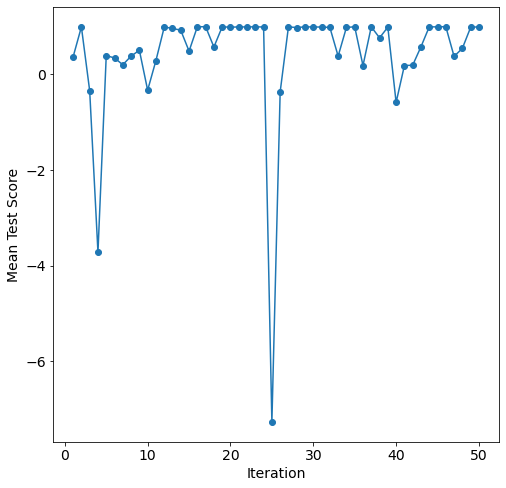
It appears to converge at around the 30th iteration.
Model Post-processing
With the top num_configs_saved, we can pass these parameter configurations to the PostProcessor for model comparison and analysis. For nn we define the epochs parameter to be 200 for better performance.
[15]:
new_model_settings = {
    "nn": {"epochs": 200}
}
postprocessor = mai.PostProcessor(
    data=data,
    models_list=[random_search_configs, bayesian_search_configs],
    new_model_settings=new_model_settings,
    yscaler=preprocessor.yscaler,
)
To compare the performance of these models we will compute 4 metrics for both the training and testing data:
mean squared error
MSE\(=\frac{1}{n}\sum^n_{i = 1}(y_i - \hat{y_i})^2\),root mean squared error
RMSE\(=\sqrt{\frac{1}{n}\sum^n_{i = 1}(y_i - \hat{y_i})^2}\),mean absolute error
MAE= \(=\frac{1}{n}\sum^n_{i = 1}|y_i - \hat{y_i}|\),and r-squared
R2\(=1 - \frac{\sum^n_{i = 1}(y_i - \hat{y_i})^2}{\sum^n_{i = 1}(y_i - \bar{y_i})^2}\),
where \(y\) is the actual outcome, \(\bar{y}\) is the average outcome, \(\bar{y}\) is the model predicted outcome, and \(n\) is the number of observations.
[16]:
postprocessor.metrics()
[16]:
| Model Types | Parameter Configurations | Train R2 | Train MAE | Train MSE | Train RMSE | Test R2 | Test MAE | Test MSE | Test RMSE | |
|---|---|---|---|---|---|---|---|---|---|---|
| 0 | linear | {'copy_X': True, 'fit_intercept': True, 'n_job... | 0.999922 | 0.000046 | 4.393845e-09 | 0.000066 | 0.999943 | 0.000039 | 2.718327e-09 | 0.000052 |
| 1 | lasso | {'alpha': 0.00014534810804869164} | 0.999539 | 0.000129 | 2.586986e-08 | 0.000161 | 0.999493 | 0.000120 | 2.433484e-08 | 0.000156 |
| 2 | lasso | {'alpha': 0.00014581414227680752} | 0.999537 | 0.000129 | 2.600405e-08 | 0.000161 | 0.999490 | 0.000121 | 2.446925e-08 | 0.000156 |
| 3 | lasso | {'alpha': 0.00023820902388072067} | 0.998912 | 0.000200 | 6.109612e-08 | 0.000247 | 0.998760 | 0.000190 | 5.950986e-08 | 0.000244 |
| 26 | nn | {'batch_size': 8, 'learning_rate': 0.000895759... | 0.998786 | 0.000184 | 6.819188e-08 | 0.000261 | 0.998717 | 0.000172 | 6.160771e-08 | 0.000248 |
| 4 | lasso | {'alpha': 0.00024356169338852368} | 0.998867 | 0.000204 | 6.364692e-08 | 0.000252 | 0.998708 | 0.000195 | 6.205178e-08 | 0.000249 |
| 30 | nn | {'batch_size': 63, 'learning_rate': 0.00095445... | 0.998932 | 0.000170 | 5.998744e-08 | 0.000245 | 0.998597 | 0.000168 | 6.734411e-08 | 0.000260 |
| 5 | lasso | {'alpha': 0.000256506780154024} | 0.998753 | 0.000214 | 7.005040e-08 | 0.000265 | 0.998575 | 0.000204 | 6.843109e-08 | 0.000262 |
| 29 | nn | {'batch_size': 8, 'learning_rate': 0.000913485... | 0.997883 | 0.000263 | 1.188860e-07 | 0.000345 | 0.997939 | 0.000240 | 9.895146e-08 | 0.000315 |
| 27 | nn | {'batch_size': 8, 'learning_rate': 0.000902521... | 0.998082 | 0.000287 | 1.076765e-07 | 0.000328 | 0.997848 | 0.000280 | 1.033429e-07 | 0.000321 |
| 28 | nn | {'batch_size': 8, 'learning_rate': 0.000888746... | 0.997937 | 0.000304 | 1.158278e-07 | 0.000340 | 0.997711 | 0.000295 | 1.099015e-07 | 0.000332 |
| 15 | svr | {'degree': 1, 'gamma': 'scale', 'kernel': 'lin... | 0.935440 | 0.001539 | 3.625248e-06 | 0.001904 | 0.922994 | 0.001510 | 3.697144e-06 | 0.001923 |
| 11 | svr | {'degree': 3, 'gamma': 'scale', 'kernel': 'lin... | 0.935440 | 0.001539 | 3.625248e-06 | 0.001904 | 0.922994 | 0.001510 | 3.697144e-06 | 0.001923 |
| 12 | svr | {'degree': 3, 'gamma': 'scale', 'kernel': 'lin... | 0.935440 | 0.001539 | 3.625248e-06 | 0.001904 | 0.922994 | 0.001510 | 3.697144e-06 | 0.001923 |
| 13 | svr | {'degree': 1, 'gamma': 'auto', 'kernel': 'line... | 0.935440 | 0.001539 | 3.625248e-06 | 0.001904 | 0.922994 | 0.001510 | 3.697144e-06 | 0.001923 |
| 14 | svr | {'degree': 4, 'gamma': 'scale', 'kernel': 'lin... | 0.935440 | 0.001539 | 3.625248e-06 | 0.001904 | 0.922994 | 0.001510 | 3.697144e-06 | 0.001923 |
| 17 | rforest | {'criterion': 'poisson', 'max_features': None,... | 0.987259 | 0.000657 | 7.154440e-07 | 0.000846 | 0.914143 | 0.001549 | 4.122079e-06 | 0.002030 |
| 16 | rforest | {'criterion': 'poisson', 'max_features': 6, 'm... | 0.981090 | 0.000787 | 1.061829e-06 | 0.001030 | 0.911553 | 0.001549 | 4.246429e-06 | 0.002061 |
| 19 | rforest | {'criterion': 'squared_error', 'max_features':... | 0.978982 | 0.000841 | 1.180233e-06 | 0.001086 | 0.908445 | 0.001591 | 4.395637e-06 | 0.002097 |
| 18 | rforest | {'criterion': 'absolute_error', 'max_features'... | 0.975491 | 0.000906 | 1.376239e-06 | 0.001173 | 0.907988 | 0.001590 | 4.417570e-06 | 0.002102 |
| 20 | rforest | {'criterion': 'poisson', 'max_features': 6, 'm... | 0.966660 | 0.001047 | 1.872149e-06 | 0.001368 | 0.896801 | 0.001666 | 4.954699e-06 | 0.002226 |
| 22 | knn | {'leaf_size': 20, 'n_neighbors': 6, 'p': 4, 'w... | 1.000000 | 0.000000 | 0.000000e+00 | 0.000000 | 0.868669 | 0.001835 | 6.305312e-06 | 0.002511 |
| 21 | knn | {'leaf_size': 13, 'n_neighbors': 6, 'p': 5, 'w... | 1.000000 | 0.000000 | 0.000000e+00 | 0.000000 | 0.867161 | 0.001838 | 6.377698e-06 | 0.002525 |
| 24 | knn | {'leaf_size': 6, 'n_neighbors': 5, 'p': 4, 'we... | 1.000000 | 0.000000 | 0.000000e+00 | 0.000000 | 0.864873 | 0.001826 | 6.487579e-06 | 0.002547 |
| 23 | knn | {'leaf_size': 28, 'n_neighbors': 5, 'p': 3, 'w... | 1.000000 | 0.000000 | 0.000000e+00 | 0.000000 | 0.861551 | 0.001847 | 6.647085e-06 | 0.002578 |
| 25 | knn | {'leaf_size': 17, 'n_neighbors': 4, 'p': 3, 'w... | 1.000000 | 0.000000 | 0.000000e+00 | 0.000000 | 0.860524 | 0.001908 | 6.696392e-06 | 0.002588 |
| 9 | dtree | {'max_depth': 10, 'max_features': 6, 'min_samp... | 0.908292 | 0.001718 | 5.149704e-06 | 0.002269 | 0.793738 | 0.002487 | 9.902836e-06 | 0.003147 |
| 7 | dtree | {'max_depth': 43, 'max_features': 6, 'min_samp... | 0.933476 | 0.001472 | 3.735503e-06 | 0.001933 | 0.770848 | 0.002643 | 1.100178e-05 | 0.003317 |
| 10 | dtree | {'max_depth': 16, 'max_features': 6, 'min_samp... | 0.979714 | 0.000790 | 1.139137e-06 | 0.001067 | 0.762098 | 0.002733 | 1.142190e-05 | 0.003380 |
| 6 | dtree | {'max_depth': 19, 'max_features': 6, 'min_samp... | 0.924182 | 0.001582 | 4.257388e-06 | 0.002063 | 0.750213 | 0.002679 | 1.199250e-05 | 0.003463 |
| 8 | dtree | {'max_depth': 16, 'max_features': 4, 'min_samp... | 0.925655 | 0.001572 | 4.174666e-06 | 0.002043 | 0.720919 | 0.002856 | 1.339895e-05 | 0.003660 |
The top performing models are linear, lasso, nn, and svr; however, rforest is above 0.90 test r-squared. Given the linear models are the most performant models we can safely saw this data set is linear. We can see that knn and dtree are overfit given the difference between Train R2 and Test R2.
We can see the hyper-parameter configurations of each top Test R2 model with the get_params function.
[17]:
for model in model_settings["models"]:
    print(postprocessor.get_params(model_type=model), "\n")
  Model Types  copy_X  fit_intercept n_jobs  positive
0      linear    True           True   None     False

  Model Types     alpha
0       lasso  0.000145

  Model Types  max_depth  max_features  min_samples_leaf  min_samples_split
0       dtree         10             6                 7                  6

  Model Types  degree  gamma  kernel
0         svr       3  scale  linear

  Model Types  leaf_size  n_neighbors  p   weights
0         knn         20            6  4  distance

  Model Types criterion max_features  min_samples_leaf  min_samples_split  \
0     rforest   poisson         None                 1                  3

   n_estimators
0           194

  Model Types  batch_size  learning_rate mid_num_node_strategy  num_layers  \
0          nn           8       0.000896              constant           2

   start_num_nodes
0              300
We can better visualize the performance of each model with diagonal validation plots.
[18]:
models = np.array([["linear", "lasso"], ["dtree", "svr"], ["knn", "rforest"], ["nn", None]])

fig = plt.figure(constrained_layout=fig, figsize=(10,20))
gs = GridSpec(models.shape[0], models.shape[1], figure=fig)
for i in range(models.shape[0] - 1):
    for j in range(models.shape[1]):
        if models[i, j] != None:
            ax = fig.add_subplot(gs[i, j])
            ax = postprocessor.diagonal_validation_plot(model_type=models[i, j])
            ax.set_title(models[i, j])
ax = fig.add_subplot(gs[-1, :])
ax = postprocessor.diagonal_validation_plot(model_type=models[-1, 0])
_ = ax.set_title(models[-1, 0])

linear, lasso, and nn are tightly spread near \(y = x\). The overfit of knn is apparent in the difference in spread of training compared to testing.
Validation plots tell us a similar story.
[19]:
fig = plt.figure(constrained_layout=fig, figsize=(10,20))
gs = GridSpec(models.shape[0], models.shape[1], figure=fig)
for i in range(models.shape[0] - 1):
    for j in range(models.shape[1]):
        if models[i, j] != None:
            ax = fig.add_subplot(gs[i, j])
            ax = postprocessor.validation_plot(model_type=models[i, j])
            ax.set_title(models[i, j])
ax = fig.add_subplot(gs[-1, :])
ax = postprocessor.validation_plot(model_type=models[-1, 0])
_ = ax.set_title(models[-1, 0])
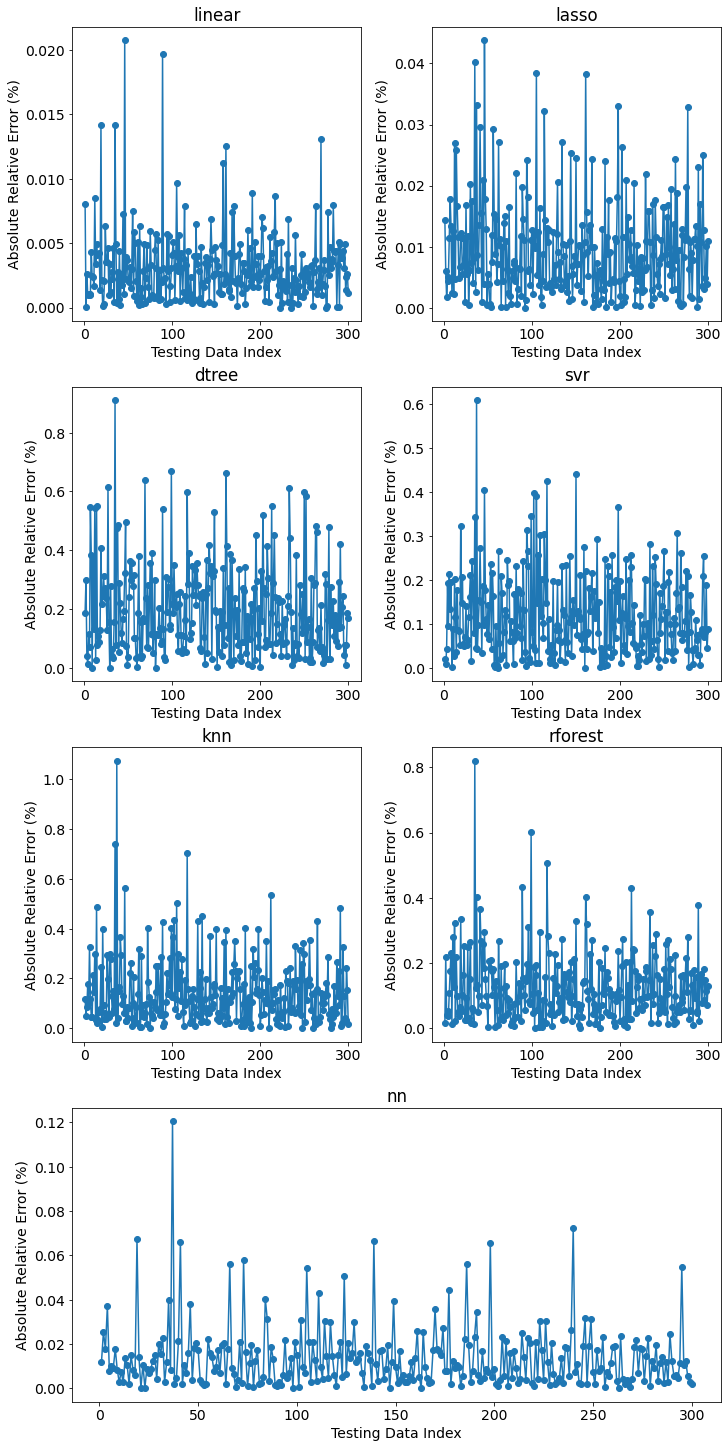
linear, lasso, and nn have all testing relative errors less than 0.10.
Finally, we can see if nn was overfit in learning curves.
[20]:
fig, ax = plt.subplots(figsize=(8,8))
ax = postprocessor.nn_learning_plot()

The validation curve is below the training curve; therefore, this nn was not overfit.
References
Radaideh, S. Surani, D. O’Grady, and T. Kozlowski, “Shapley effect application for variance-based sensitivity analysis of the few-group cross-sections,” Annals of Nuclear Energy, vol. 129, pp. 264–279, 2019.
